
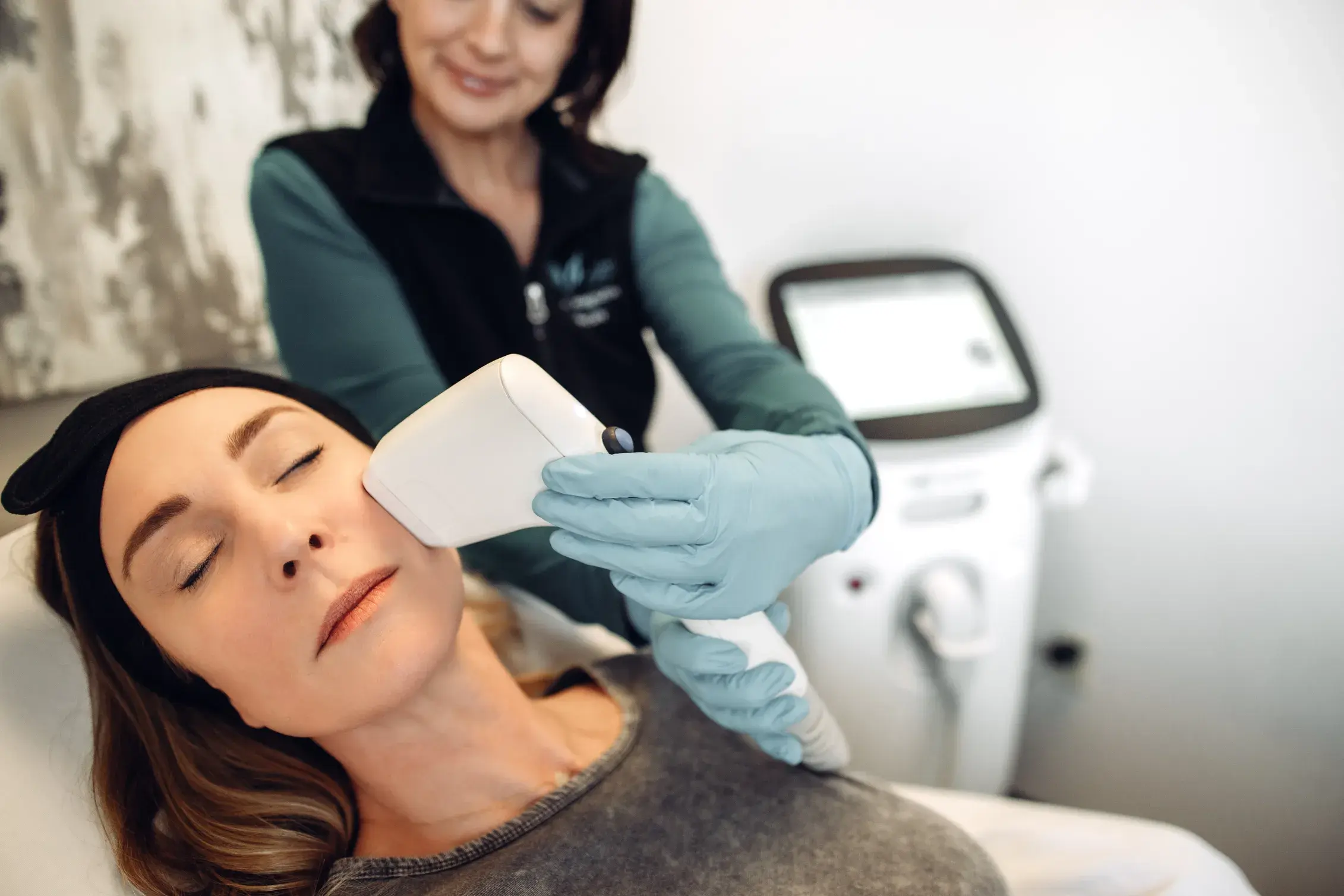

Two devices, one promise: more collagen and firmer skin without a scalpel. Sofwave skin tightening in Castle Rock and RF microneedling sit next to each other on almost every treatment menu in Colorado, and the marketing language around them is close to interchangeable. Both stimulate collagen. Both are FDA-cleared. Both are sold as the non-surgical alternative to a facelift.
The real difference is physical. Sofwave heats the dermis straight through intact skin using ultrasound. RF microneedling drives needles into the dermis and releases radiofrequency energy from the needle tips once they are seated. That single distinction shapes how the session feels, how your face looks the next morning, and which concerns actually improve.
This guide covers how each technology works, what the clinical evidence supports, and where each one earns its place in a treatment plan.
What is Sofwave, and how does it work?
Sofwave is an ultrasound platform built around SUPERB technology, short for Synchronous Ultrasound Parallel Beam. Seven transducers make direct contact with the skin and fire parallel beams into the mid-dermis, roughly 1.5 mm below the surface. That is the layer where the bulk of your collagen and elastin fibers live. The beams raise tissue temperature to approximately 60 to 70°C, which is the threshold that triggers a repair response and new collagen. A built-in cooling mechanism called SofCool protects the epidermis while the heat lands in the layer beneath it.
The skin surface stays closed for the entire session, which is why recovery is measured in hours. FDA clearances cover facial lines and wrinkles, eyebrow lifting, submental and neck lifting, cellulite, and acne scars. If you want the mechanics in more depth, we walk through them in our guide on what to expect from Sofwave in Castle Rock.
What is RF microneedling, and how does it work?
RF microneedling combines two established treatments in one handpiece. A cartridge of fine needles penetrates the skin to a set depth, adjustable on most devices between roughly 0.5 mm and 3.5 mm. Once the needles are seated, they emit radiofrequency energy that heats the surrounding dermal tissue. The needles create mechanical microchannels that trigger the skin’s natural repair cascade, the same principle behind microneedling with PRP in Castle Rock. The radiofrequency energy then adds thermal coagulation zones around each needle tract, which drives collagen contraction deeper than needles alone can reach.
RF microneedling is a category, not a single machine. Morpheus8, Vivace, Secret RF, Potenza, and Sylfirm X all belong to it, and they differ in needle count, insulation, depth range, and how the energy is pulsed. Insulated needles release energy only at the tip, concentrating heat in the deeper dermis and sparing the upper layers. Non-insulated needles release energy along the whole shaft, heating upper and lower dermis at once.
Sofwave vs. RF microneedling at a glance
The table below lays out the differences that patients notice most.
Which concerns does each one actually fix?
Both treatments stimulate collagen. Where they diverge is the geography of the injury and what that geography is useful for.
Sofwave concentrates its energy in a single horizontal plane in the mid-dermis, which produces broad, even tightening across the treated area. Patients notice it most along the jawline, under the chin, in the brow, and across the neck, where a modest amount of dermal contraction reads as a visible lift.
RF microneedling distributes energy in vertical columns through the dermis, leaving untreated tissue between each column. That pattern suits resurfacing problems: atrophic acne scars, enlarged pores, crepey texture, and stretch marks. Because needle depth is adjustable, the same device that treats a cheek can be reconfigured for an abdomen or a knee. For deeper resurfacing work, some patients are better served by Pixel CO2 laser skin resurfacing in Castle Rock, which addresses scarring and photodamage on a different scale.
The practical translation is simpler than the physics:
- If the complaint is "my jawline has softened" or "my neck is starting to droop," the concern is laxity, and ultrasound is the more direct answer.
- If the complaint is "my skin feels rough" or "these acne scars never faded," the concern is texture, and needle-based energy is the more direct answer.
Which treatment hurts more?
This question decides the matter for a lot of patients, and the answer is clear.
RF microneedling requires topical numbing cream applied 30 to 45 minutes before the session, and most providers will not run the device without it. Patients describe a combination of pressure as the needles enter and a hot, prickly sensation as the energy fires. Bony areas such as the forehead and jawline register more sharply than the cheeks. At higher energy settings, some clinics add nerve blocks or nitrous oxide.
Sofwave is the gentler experience by a wide margin. The applicator glides across the skin delivering pulses of warmth, and most patients report brief stinging over the more sensitive areas. Numbing cream is available and frequently skipped. That comfort gap has a downstream effect that matters more than it sounds: patients who found a treatment tolerable come back for their maintenance session, and maintenance is what preserves the result.
Quick takeaway: Sofwave asks for 30 to 45 minutes and no preparation. RF microneedling asks for numbing time, a higher pain tolerance, and a clear calendar afterward. If you are weighing ultrasound options against each other rather than against needles, our comparison of Sofwave and Ultherapy covers that side of the decision.
What does recovery look like?
After Sofwave, you leave and go about your day. Mild redness is common and typically resolves within a few hours. Makeup goes on the same afternoon, and there is no peeling or bruising to manage.
After RF microneedling, the treated skin carries a visible grid of pinpoint marks from the needle entries. Redness reads like a sunburn for 24 to 72 hours, and swelling usually peaks on day two before settling. Most patients look presentable somewhere between day three and day five, though deep settings used for scar revision can leave marks visible for a full week. Aftercare generally means no makeup for 24 hours and no sweating or sun exposure for 48.
That gap changes how you schedule. A Sofwave session fits into the week of an event. RF microneedling needs a runway of a week or two before anything you will be photographed at.
How long do results take, and how long do they last?
With Sofwave, collagen and elastin production begin within weeks of a single session. Most patients notice firming at four to six weeks, and the tissue continues remodeling for about three months. Results generally hold for one to two years, depending on age and skin condition.
In the multicenter clinical trial submitted for FDA clearance, 86% of subjects showed improvement of one to three units on the Fitzpatrick Wrinkle and Elastosis Scale twelve weeks after a single treatment, with no device-related adverse events recorded (source).
RF microneedling works on a longer arc. Dermal remodeling after radiofrequency needling is slow and progressive, and the published review evidence shows improvement continuing even six months after the last session. Most protocols call for three treatments spaced four to six weeks apart, so the clock on your final result starts months after your first appointment. Results typically hold for around a year.
The trade is straightforward. Sofwave gives you a shorter path to a visible change from one visit. RF microneedling asks for a series and rewards patience with structural remodeling that keeps developing.
Is either option safer for darker skin tones?
Both are considered safe across Fitzpatrick skin types I through VI, which is a genuine advantage over ablative resurfacing. The nuance sits in pigment risk.
Sofwave delivers no light energy targeted at a chromophore, so melanin does not absorb it and skin tone has no bearing on how the energy behaves. Pigment complications are rare.
Radiofrequency is also melanin-independent in principle, since it heats tissue through resistance rather than color absorption. That property is exactly why RF microneedling became a preferred energy device for skin of color. Post-inflammatory hyperpigmentation still shows up occasionally, and when it does it tends to trace back to aggressive settings or heat reaching the epidermis. Insulated-needle devices reduce that risk by keeping the energy at the needle tip.
Can you combine them?
Yes, and for many patients that beats picking a winner. Laxity and texture are separate problems, and one face can carry both.
A common sequence addresses texture first with needle-based treatment, then tightens with Sofwave once the skin has fully healed, usually four to six weeks later. Running Sofwave first and resurfacing afterward works as well. Sofwave also pairs cleanly with dermal fillers in Castle Rock when volume loss is part of the picture, since firmness and volume are different deficits that respond to different tools.
Deciding the order is easier with data. An Alma IQ skin analysis in Castle Rock reads your skin across multiple layers in about ten seconds and shows whether laxity or texture is the dominant issue, which turns the sequencing question into an answerable one.
Who should choose which?
The right pick depends on the concern that brought you in and the recovery you can absorb.
Sofwave makes more sense if you:
- Have mild to moderate laxity along the jawline or neck and want lifting without needles through the skin.
- Cannot clear several days for redness and swelling, or would rather do one session a year than a series.
RF microneedling makes more sense if you:
- Have atrophic acne scars, enlarged pores, or crepey texture as your primary complaint.
- Are willing to trade downtime and a course of treatments for resurfacing that ultrasound was never designed to deliver.
Neither treatment substitutes for a surgical facelift in patients with severe laxity. For the large group of people in their late 30s through their 60s who want visible improvement without an operation, both deliver measurable change in their respective lanes.
What supports your results afterward?
Collagen production declines with age regardless of what device you sat under, so results from either treatment fade on a schedule your biology sets. Daily sun protection does more to protect an aesthetic investment than any single procedure, which matters at Castle Rock’s elevation, where ultraviolet exposure runs higher than most patients assume. A medical-grade skincare routine between sessions keeps the barrier healthy and extends the window before you need a touch-up.
The bottom line
Sofwave and RF microneedling are both well-evidenced, FDA-cleared treatments with real clinical data behind them. They answer different questions.
For skin laxity, Sofwave is the more comfortable route with a single session, no broken skin, and a same-day return to normal life. For acne scarring and rough texture, RF microneedling does resurfacing work that ultrasound cannot reach, and the downtime it asks for buys a structural change in the dermis.
The mistake worth avoiding is choosing based on which name your feed served you most often. Choose based on what you see in the mirror. If sagging is the story, start with ultrasound. If the surface is the story, start with needles. If both are the story, sequence them.
Not sure which one your skin needs?
Book a consultation at Colorado Integrative Health or call (303) 862-8061 and we will tell you which concern to treat first.
References
1. Wang JV, Ferzli G, Jeon H, Geronemus RG, Kauvar A. Efficacy and Safety of High-Intensity, High-Frequency, Parallel Ultrasound Beams for Fine Lines and Wrinkles. Dermatologic Surgery. 2021;47(12):1585-1589. https://pubmed.ncbi.nlm.nih.gov/34417390/
2. Tan MG, Jo CE, Chapas A, Khetarpal S, Dover JS. Radiofrequency Microneedling: A Comprehensive and Critical Review. Dermatologic Surgery. 2021;47(6):755-761. https://pubmed.ncbi.nlm.nih.gov/33577211/
3. Gold MH, et al. Efficacy and safety of high-intensity, high-frequency, non-focused ultrasound parallel beams for facial skin laxity. Journal of Cosmetic Dermatology. 2024;23(1):117-123. https://pubmed.ncbi.nlm.nih.gov/38031530/